A style name is a starting point for looking, not a complete syllabus
Tattoo styles overlap. One artist may combine illustrative drawing, fine line and ornamental composition; another may use realism with a geometric frame. Course and portfolio labels are not a universal classification system. Compare the visual decisions and the learning outcomes, not only the style name attached to a photograph.
This guide is a design-language reference. It does not claim that the Academy teaches every style below, that a short course confers cultural authority or that drawing practice demonstrates competence to tattoo a person. The current tattoo subject library is narrower than this reference guide. Future curriculum ideas remain plans until their actual course pages state otherwise.
Look at five visual decisions
Line: Is the contour continuous, varied, very fine, deliberately rough or absent? Value: How are lights, midtones and dark anchors organised? Colour: Is the palette limited, descriptive, exaggerated or secondary to black? Composition: How does the image fit its intended shape and viewing scale? Surface language: Do marks describe fur, foliage, geometry, lettering, dots or something deliberately abstract?
These questions help you compare styles without reducing them to a filter. A design's apparent detail is not the same as its clarity. Looking at a small image, an enlarged crop and a wider composition can reveal different priorities.
Japanese and expressive illustrative approaches
| Subject | What to examine in references | A useful drawing-study question |
|---|---|---|
| Japanese Irezumi | Relationships between major subjects, backgrounds and a larger composition | Can the main visual hierarchy be explained before individual motifs are copied? |
| Japanese Neo-Traditional | The way an artist interprets Japanese references with contemporary line, colour or shape choices | Which decisions belong to that artist's interpretation, and which references need cultural research? |
| American Traditional / Old School | Clear silhouette, deliberate outline and economical colour or value grouping | Does a simplified drawing still read when details are removed? |
| Neo-Traditional | Varied line hierarchy, decorative framing and selective descriptive detail | Can the focal point remain distinct from the surrounding ornament? |
| New School | Exaggeration, energetic form, stylised perspective and strong colour relationships | Is the distortion intentional and consistent throughout the drawing? |
| Illustrative | Drawing-led interpretation rather than a single fixed palette or line rule | What choices distinguish this interpretation from a direct copy of the reference? |
| Anime and Manga | Character recognition, stylisation, panel language and adaptation of a source image | Have the reference and commercial reproduction rights been considered? |
These categories are descriptive aids, not rigid tests. A portfolio may use several at once. For any imagery rooted in a particular tradition, research the meaning and context rather than choosing a motif only because it fills a space. Do not present another artist's composition or a protected character as an original commercial design you own.
Cultural tattoo traditions need context and appropriate teachers
Polynesian tattoo traditions are not one interchangeable pattern library. The broad regional label includes distinct histories and communities. A “tribal” keyword on a search page is not a basis for claiming that a design accurately represents a person's identity, relationships or cultural responsibilities.
Te Ara's account of tā moko explains its Māori context and the importance of identity, status and skilled practitioners. Kirituhi also appears in contemporary studio and course descriptions; do not assume that using that word removes the need to understand how Māori practitioners define their work and responsibilities. Seek guidance from culturally grounded sources rather than using this comparison as authority to reproduce a design. Te Ara: Tā moko
For Sāmoan tatau, Te Papa presents discussion by a Pacific curator and Sāmoan tatau artists. Learning directly from such accounts is more appropriate than treating the appearance as a generic decorative texture. The Academy does not claim authority to teach the traditional practice. Te Papa: Sāmoan tatau meanings and history
| Subject | Responsible study emphasis | Boundary to retain |
|---|---|---|
| Polynesian tattoo traditions | Study specific communities, sources and named traditions | A regional label does not make all motifs equivalent |
| Māori Tā Moko and Kirituhi | Learn terminology and context from Māori practitioners and cultural sources | Do not infer identity, permission or teaching authority from a visual reference |
| Samoan Tatau | Consider the tradition through Sāmoan voices, histories and relationships | Avoid selling generic copied motifs as traditional knowledge |
| Tribal and Neo-Tribal | Identify whether a reference describes a living tradition or a contemporary abstract approach | Name the actual context instead of grouping all black patterns together |
| Chicano | Consider lettering, imagery, narrative and the community context of a reference | A few recognisable motifs are not a complete cultural account |
Geometry, ornament and black-based design
| Subject | What to examine | Drawing-study emphasis |
|---|---|---|
| Geometric | Repetition, alignment, intervals and the relation between shapes | Consistent spacing and intentional variation |
| Sacred Geometry | The source and intended meaning of a geometric reference | Separate mathematical construction from unverified spiritual claims |
| Mandala | Radial organisation, hierarchy and the cultural context of particular references | Repeat a structure accurately without claiming ownership of traditional symbolism |
| Ornamental | The relationship between decoration, framing and the main subject | Decide what frames the focal point and what competes with it |
| Dotwork | Distribution and density of visible marks | Group marks into readable values instead of treating every dot as independent detail |
| Blackwork | The balance of solid dark areas, edge shapes and open space | Read the silhouette and negative space together |
| Blackout | Large-area visual coverage and its relationship to the body and existing work | Design analysis is not practical training for extensive coverage |
| Cybersigilism | Contemporary angular, branching or symbol-like mark making | Explain the particular artist's composition instead of inventing a universal historical meaning |
For geometry, working accurately on a flat page is a useful first exercise, but it does not answer how a design should be adapted to an individual body or applied safely. Make the paper study clearly labelled as a drawing study. Do not imply that a printable grid is a practical qualification.
Fine line, minimal and texture-led approaches
| Subject | What to examine | Drawing-study emphasis |
|---|---|---|
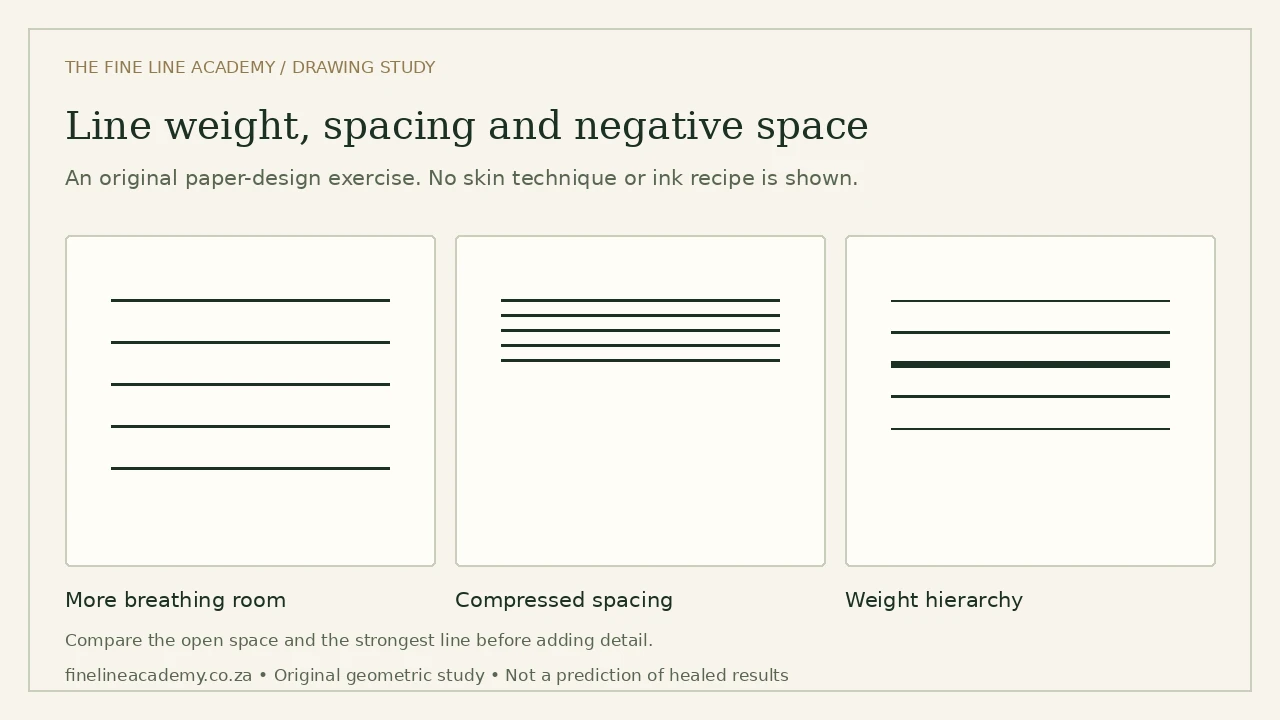
| Fine Line | Line hierarchy, open space and selective detail | Keep essential information readable at the intended size |
| Single Needle | Whether the label describes a tool choice or the visual result | Do not assume a photographed appearance proves a particular configuration |
| Minimalist | The few elements doing most of the visual work | Remove a detail and assess what information is lost |
| Watercolour | Colour edges, transparency-like effects and the supporting structure | Distinguish an intentional loose edge from an unresolved drawing |
| Sketch | Deliberate construction marks, variation and expressive line | Show which marks are retained for meaning rather than by accident |
| Etching and Engraving | Directional line systems and built-up value | Keep groups of marks consistent with the form they describe |
| Lettering and Calligraphy | Letter construction, spacing, rhythm and legibility | Check the actual words and references as carefully as the decoration |
“Single needle” is not a synonym for every fine-line image, just as “minimalist” does not mean a design needs no planning. Compare the actual line and spacing decisions. The Fine Line Design Foundations outline and free design checklist address the related drawing questions.
Realism and representational subjects
| Subject | What to examine | Drawing-study emphasis |
|---|---|---|
| Black and Grey Realism | Proportion, tonal grouping, edges and focal detail | Establish the large value relationships before texture |
| Colour Realism | Colour relationships alongside drawing and value | Check whether the form still reads when colour is reduced |
| Micro-Realism | Detail selection at a small intended scale | Analyse what must be simplified rather than promising tiny detail will remain unchanged |
| Portrait Realism | Proportional relationships, expression and recognisable structure | Use suitable reference rights and do not replace careful drawing with a filter |
| Wildlife Realism | Species-specific form, direction of texture and believable pose | Verify anatomy and reference quality before decorative additions |
| Botanical and Floral Realism | Plant structure, growth direction, overlap and identifiable features | Check botanical references rather than assembling unrelated leaf shapes |
Realism is not a requirement to reproduce every visible strand, pore or vein. Select information that explains the subject at its intended viewing size. A convincing reference image is also not proof of how a tattoo looks after healing; ask to see appropriately described work and avoid claims that a style cannot change over time.
Read the shading and greywash theory guide for paper-based value studies. Practical realism instruction, where pursued, needs its own training scope and assessment rather than being assumed from a design-theory outline.
Hybrid, conceptual and larger compositions
| Subject | What to examine | Drawing-study emphasis |
|---|---|---|
| Biomechanical | The invented relationship between mechanical structure and organic form | Keep the invented structure internally consistent |
| Bio-Organic | Flowing, organic-looking forms and the transitions between them | Decide which edges and rhythms organise the abstraction |
| Surrealism | The visual logic connecting unexpected subjects or scales | Make the intended contradiction readable rather than merely adding unrelated objects |
| Trash Polka | The specific reference's combination of imagery, graphic marks and contrast | Study a named artist's work without copying a composition or implying affiliation |
| Patchwork Tattoo Composition | The relationships between separate pieces, gaps and changing scales | Plan the collection as well as each individual image |
Hybrid work benefits from a clear reason for each element. A border, word, portrait and geometric pattern do not automatically form one coherent composition. Make a thumbnail with only the major masses, then ask which elements support the intended reading order.
How to turn this reference into a learning plan
Choose a small group of references with clear permissions and context. Describe the line, value, colour, composition and texture decisions in your own words. Produce an original paper study that tests one of those decisions, not a replica offered for sale. Then identify what feedback would help you judge it.
If you are comparing a course, look for outcomes that match the study: drawing, design planning, theory, demonstration or assessed practical work. This guide supports research across the styles named above; it is not a catalogue of completed Academy style courses. Use the current course outlines for actual scope, fees and release status, and the training comparison for questions about format and supervision.
Published by The Fine Line Academy, an independent online education brand based in South Africa. This public guide supports informed learning choices; it is separate from paid student materials. About the Academy · Suggest a factual correction